
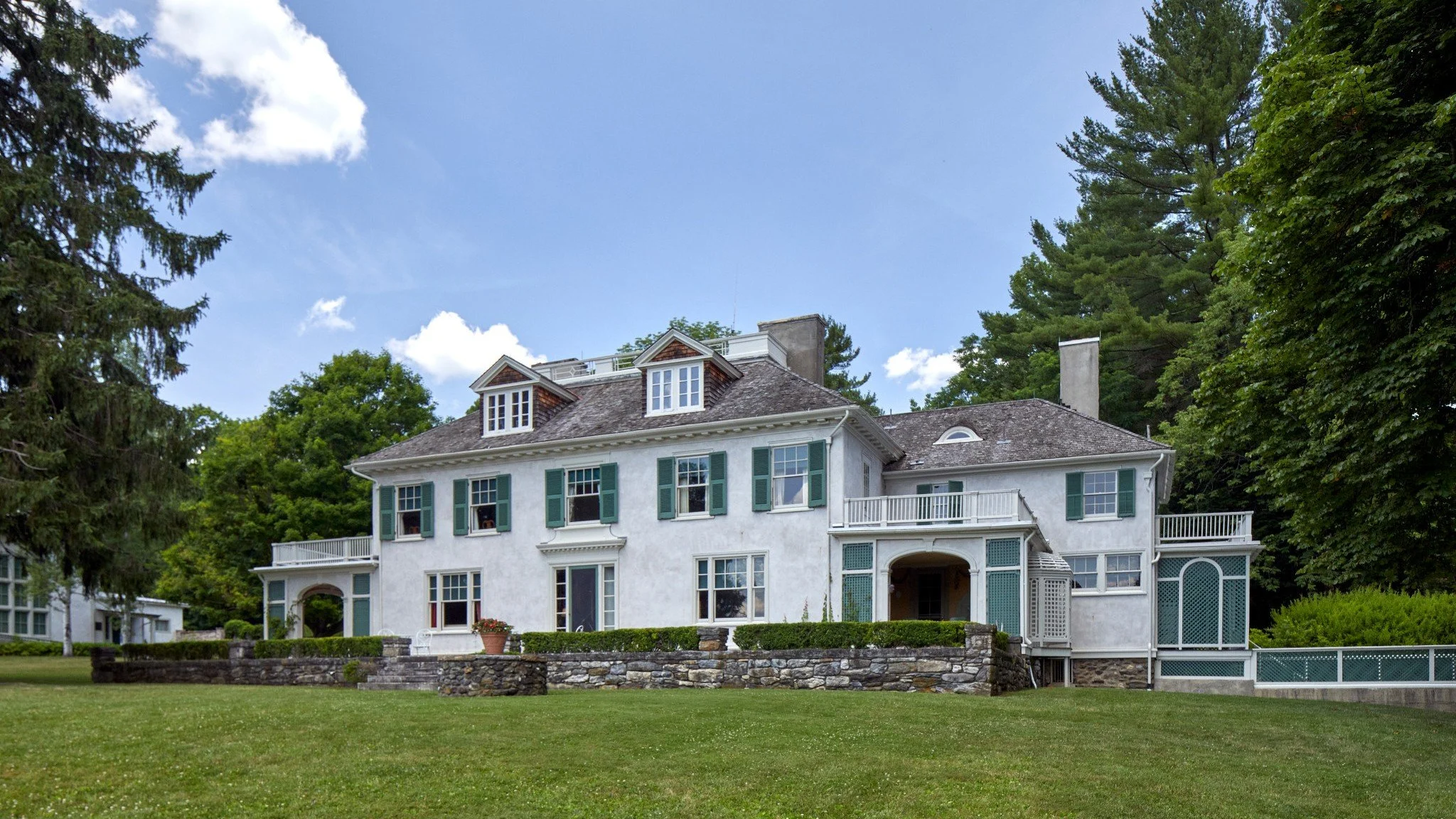
The Residence
Completed in 1901, the three-floor, stucco-clad Residence was designed by Henry Bacon, later renowned as the architect of the Lincoln Memorial in Washington D. C. With nine bedrooms in the Residence, French was able to host many seasonal guests, and house a small staff year-round.
The Residence incorporates several architectural styles: English Georgian, American Colonial Revival, and references to Italian villa architecture. The exterior bears generalized Colonial Revival details (symmetry, dormers, and shutters). The siting of the house on a ridge with splendid views from the porches and terraces is more likely drawn from Italian sources. The overall design must have deeply appealed to French, because it combined the form of his grandfather’s beloved Chester, NH, Colonial Revival house with nostalgic references to the architecture seen during his Italian travels. The Residence’s exterior features another family connection: French’s sister-in-law, Alice Helm French, applied fresco images of flower and fruit garlands to the Breakfast Porch’s pale yellow walls. For the next thirty-one years, she continued to retouch frescoes as they weathered.
The Residence contains antique furnishings that were either family heirlooms or bought by the sculptor at local antique auctions. Some elements were reused or recycled from other structures. French was a proponent of “adaptive reuse,” and repurposed the original Warner farmhouse’s doors, molding, and fireplace surround. He installed silver-plated knobs and hinges rescued from a New York City townhouse under demolition. Although French’s daughter made changes in furnishings, decoration, and structure after Chesterwood passed to her ownership, the house is essentially the same as it was when it served as the family’s summer retreat.
The Studio
In 1897, French commissioned his friend and colleague Henry Bacon to design a studio.[1] French thought the best site would be where the barn then stood, offering a majestic view of Monument Mountain. Construction on the studio began in April 1898 and three months later, impatient to occupy his new workspace despite its final completion two weeks away, French started working there on on July 16. By August 6, he was receiving callers.[2]
A reception room was standard for fashionable artists’ studios of French’s time, as a gathering place where business visitors were received. It was there that French relaxed by drawing and painting oil or pastel portraits of friends, family, or neighbors in the north light of the French windows. The family’s afternoon tea took place there when inclement weather precluded use of the south-facing piazza, a 50-foot long porch with the view that the sculptor so enjoyed.
The main work space of the Studio is a 30 x 29-foot room with 26-foot high walls which provided ample space for heroic equestrian models. Along with provisions for excellent natural lighting, French had other exceptional requirements since so much of his work was designed to be placed outdoors. To be able to view work in progress en plein air, French devised an ingenious scheme for moving sculpture outside of the Studio with relative ease. Part of the studio floor is, in fact, a standard gauge flatcar that, by the removal of adjacent floor panels, can be pushed outdoors on tracks. French, therefore, could judge his works’ effect in the open. Often, French would view his work by standing down in the field in order to get the appropriate viewing distance.
It was in the adjacent casting room that clay models were cast into plaster for further sculptural development and later casting in bronze. Through trap doors, plaster casts and discarded clay models were lowered to be dealt with in the cellar.